
United States Department of Agriculture
AgResearch Magazine


Keeping Small Catfish From Straying
|
|
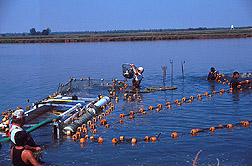 At a commercial farm near Belzoni, Mississippi, ARS researchers and fish farmers sample catfish to determine effeciency of the new, mechanized floating platform grader. (K8952-1) |
Catfish processors pay the highest prices for what consumers want: fish weighing between three-quarters of a pound and 2 pounds. To reduce the number of fish marketed ahead of their time, growers have until now used nets designed to haul in only the big ones. But nets sometimes don't work too well, especially on cooler days when some of the little guys hang in with the big guys. The small fish, called shorts, can make up to 20 percent of a net's load and must be removed by hand. Now a new, mechanized floating platform grader sorts the shorts and keeps them down on the farm longer. "When the small fish aren't harvested in the first place, producers and processors benefit financially," says ARS food technologist Donald W. Freeman who heads up aquaculture research at Pine Bluff, Arkansas. Those small fish that miss getting sorted out at the farm cost more in time and labor, pound for pound, to process than larger fish. Though fish processing is mostly mechanized, small fish must be dressed by hand and that causes a bottleneck, costing the industry more than $11 million a year. Add in farmers' lost opportunity to grow and market larger fish and the cost mounts to $44 million, according to industry estimates. To solve the problem, a coalition comprising producers, processors, specialists of the University of Arkansas at Pine Bluff Cooperative Extension Program, and high school students joined forces with ARS, which provided funds and collaboration. David Heikes, a fisheries specialist at the University's Aquaculture/Fisheries Center, Pine Bluff, had designed a small-scale grader. He patterned it somewhat on the order of bar graders used in tanks for smaller size ranges of fish called fingerlings. The high school welding students of the Jefferson Area Vocational Center's outreach program built a larger prototype stretching more than 20 feet. It's made of metal, polyvinyl chloride pipe, wire mesh netting, and wood. One distinguishing feature of the new grader, besides its size, is that it rests on four aluminum floats, so a horizontal grader platform can be submerged at various depths. Fish are gently herded by boat to the platform grader. Up the grader's inclined loading chute they go, with a flow created by a safely screened 25-horsepower motor in the chute. The water current moves them up to and across the grader platform where the smaller fish swim out through bars that can be adjusted to retain the needed size fish. At the end of the platform, a person controls the speed of the operation and lifts a sliding gate to load batches of fish for grading. "In sorting tests under commercial conditions, researchers processed nearly 20 tons of fish per hour," said Freeman. "The grader effectively sorted out most of the undersized fish, allowing only 5 percent to go to the processor. This was down from the normal rate of 20 percent." With more training, operators of the equipment may be able to harvest even fewer small fish. Improved sorting will also result from further design modifications that are now under way.—By Ben Hardin, Agricultural Research Service Information Staff. This research is part of Aquaculture, an ARS National Program (#106) described on the World Wide Web at http://www.nps.ars.usda.gov/programs/appvs.htm. Donald W. Freeman is at the Harry K. Dupree Stuttgart National Aquaculture Research Center, P.O. Box 860, Stuttgart, AR 72160; phone (870) 673-4483, fax (870) 673-7710. |
|
"Keeping Small Catfish From Straying" was published in the July 2000 issue of Agricultural Research magazine. |
|
