
United States Department of Agriculture
AgResearch Magazine


Fuzzy Leaves Confuse Fungi
|
|
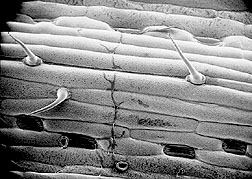
Like snakes on the head of the mythical Greek Medusa, leafhairs on the surface of wheat and rye plants entangle and confuse germinating fungal spores. This protects these important grain crops from disease, say scientists at the ARS Cereal Rust Laboratory in St. Paul, Minnesota.
Puccinia recondita, a fungal disease of wheat and rye, infects thousands of acres of both crops each year and causes millions of dollars in crop losses, says plant pathologist David Long. The fungus is called a rust because it discolors leaves and makes diseased plants appear as though they are oxidizing, or rusting.
Based on pioneering work by ARS plant pathologist John Roberts, who is now retired, Long and others were able to test a theory proposed by the late N.A. Cobb. That USDA plant pathologist theorized that plant leaf hairs interfere with fungal infection. The scientists examined leaf surfaces with a scanning electron microscope. They found that when fungal spores land on a leaf surface, they send out tiny "infection tubes" that seek out the plant's stomata--minuscule openings in the leaf surface that allow the exchange of carbon dioxide.
"When a spore lands on a leaf surface with a lot of leaf hairs, it becomes 'confused' and dies before the infection tube can locate a stoma to complete the fungus' life cycle," says Long.
He and Roberts showed a 27-percent reduction in disease infestation in wheat and rye hybrids with higher numbers of leaf hairs. "We think this is good information for wheat and rye breeders to take under consideration when developing new varieties," says Long. "In addition, the leaf hairs also confer resistance to some insect pests." — By Dawn Lyons-Johnson, ARS.
David L. Long is at the USDA-ARS Cereal Rust Laboratory, University of Minnesota, St. Paul, MN 55108; telephone (612) 625-1284.
