
United States Department of Agriculture
AgResearch Magazine


Plant Pigments Paint a Rainbow of Antioxidants
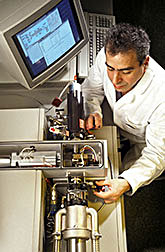 Using high-performance liquid chromatography, chemist Frederick Khachik analyzes an extract of human blood for dietary carotenoids and their metabolites. (K7496-1) |
For millions of years, insects have relied on flower color to find the right food source. Now nutrition researchers are discovering that the rainbow of color pigments in fruits and vegetables may do more than simply attract attention or please the eye.
The orange pigment, beta carotene—best known of the plant color compounds—first caught researchers' eyes when population studies linked low rates of certain cancers with a high intake of fruits and vegetables containing lots of beta carotene.
A current theory holds that cancer, heart disease, stroke, and other diseases of aging result from cumulative damage to cells by free radicals—most of which our cells generate through ordinary metabolism. So nutrition and medical researchers are dissecting the fruits and vegetables consumed by healthy populations, looking for the best combinations to prevent such damage.
What they are finding is that fruits and vegetables contain hundreds of other pigments besides beta carotene—as well as nonpigment compounds—that may play a role in preventing oxidative damage.
Studies to date suggest certain plant chemicals, or phytochemicals, appear to maintain health by boosting the immune system, reducing inflammation and allergies, detoxifying contaminants and pollutants, and/or activating enzymes that block unbridled cell division.
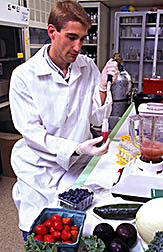 Research technician John McEwen prepares fruits and vegetables for the chromatographic separation of antioxidant components. (K7495-2) |
Fred Khachik, a chemist with ARS, points out that the diets of most people supply more of two other carotenoids—lutein and lycopene—than they do beta carotene.
"The results from epidemiological and human studies can be better interpreted if the bioavailability, metabolism, and potential cancer-preventive effects of these other major dietary carotenoids are also studied," he says.
And that's what Khachik has been doing for the past 13 years. He and colleague Gary Beecher, who heads food composition research at ARS' Beltsville (Maryland) Human Nutrition Research Center (BHNRC), have tailored several analytical processes to search for carotenoids in human blood, tissue, and breast milk, as well as in foods.
Of the 50 or 60 carotenoids in foods, 7 had been found in blood serum and breast milk before Khachik began his studies. He identified eight more. Presumably, they have some useful function or the body wouldn't expend the effort to selectively absorb them, he says.
In addition, Khachik has found eight metabolic byproducts, or metabolites, made by three of these carotenoids. Most of these metabolites are oxidized forms of lutein and its alter ego, zeaxanthin, which is in foods in much lower concentrations. Two are oxidized forms of lycopene.
"We know these oxidized metabolites aren't in the foods," he says. "And we're not creating them in the laboratory."
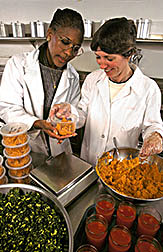 Dietitian Evelyn Lashley (left) and food service worker Sara Mayock weigh kale, tomato juice, and sweetpotatoes for a carotenoid study with human volunteers. (K7496-3) |
The fact that they are in blood suggests that lutein and lycopene behave as antioxidants, counteracting the assaults of free radicals and thus sparing crucial biological chemicals from damage. And there's some evidence that carotenoids and their metabolites activate enzymes involved in detoxifying contaminants or blocking the unrestrained increase in cancer cells, Khachik adds.
What's more, lutein may help prevent the leading cause of blindness in the elderly—macular degeneration—which results from long-term deterioration of the center of the retina, known as the macula.
Khachik says that a study reported in 1994 by Harvard researchers found that people with the highest intake of fruits and vegetables, especially those rich in lutein, had half the risk of macular degeneration as those with the lowest intake. In his own analysis of extracts from human retinas, he found lutein, zeaxanthin, and several of their oxidized metabolites—but no other carotenoids.
Lutein—along with several other carotenes—gives summer squash, apricots, peaches, and oranges their yellow to light-orange color. But its richest sources are kale, spinach, and collard greens, in which the yellow pigment is masked by the more abundant green chlorophyll pigments.
Lycopene gives tomatoes their bright red hue and invariably stains our clothes when we indulge in a plate of spaghetti. High intakes may protect against prostate cancer. In a study of men 40 years and older, those who consumed more than 10 servings of tomato products per week had two-thirds the risk of prostate cancer as those who ate less than 1.5 servings weekly.
"Lutein and lycopene possess exceptionally high antioxidant capacity compared to other carotenoids and may be useful in preventing cancer," says Khachik.
How Much Gets in Us?
Khachik has shown that blood levels of lutein go up when people take pure lutein supplements. But how much do they rise when the digestive tract has to sort through the fiber and thousands of other compounds found in carotenoid-rich foods? That question inspired the formation of the BHNRC Carotenoids Research Unit headed by nutritionist Bev Clevidence.
In a recent study, she and 11 colleagues lunched on kale, tomato juice, and sweetpotatoes every day for 3 weeks to test how well lutein, lycopene, and beta carotene are absorbed from foods rich in these antioxidants and to look at some of their effects in the body.
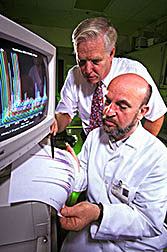 Scientific program officer Ronald L. Prior (left) and visiting scientist Emin Sofic evaluate antioxidant components of strawberries. (K7495-1) |
They looked for changes in both oxidative damage to blood lipids and DNA and the immune system's ability to mobilize its defenses.
"We wanted to know if people could get enough of these carotenoids from realistic food portions to have any benefit," says Clevidence.
In a study of 1,300 elderly people living in Massachusetts, she notes, the subjects who reported the highest intakes of dark-green and deep-yellow vegetables were half as likely to die from cardiovascular disease 5 years later and one-third as likely to die from cancer as those with the lowest intakes.
"The highest intakes averaged slightly more than two servings daily, and the lowest intakes averaged less than one," she says. "So adding two more servings of these dark-green and yellow vegetables each day may confer significant health benefits.
By selecting vegetables rich in lutein (kale), lycopene (tomato juice), and beta carotene (sweetpotato), the Beltsville researchers managed to consume 20 milligrams (mg) of each carotenoid, or 60 mg total.
"This is a tenfold increase over typical U.S. carotenoid intakes," says Clevidence, "and it was achieved with very tolerable servings." Lunch consisted of less than 5 ounces of steamed kale, about 5.5 ounces of mashed sweetpotato, and 6 to 8 fluid ounces of tomato juice.
Beta carotene proved to be the most bioavailable, increasing 116 percent in blood plasma during the treatment period. Lutein increased 67 percent, on average, but blood levels were quite variable among the 12 volunteers. Lycopene had the lowest bioavailability, with a 26-percent increase. Khachik also saw a small increase in the oxidized metabolites of lutein and lycopene in blood, indicating that the carotenoids were taking hits from free radicals.
A close inspection of colon cells by Beltsville colleague Padmanabhan Nair suggests that the bulk of these carotenoids may be providing protection within cells, rather than circulating in the plasma. He found huge increases ranging from 1,000 percent for lycopene to 4,000 percent for beta carotene.
Despite these increases, the researchers found no change in oxidation of blood lipids, suggesting that protection may be occurring in tissues rather than blood. And they saw no more protection of DNA, based on breakdown products in the urine.
They did, however, find a significant improvement in immune function. Immunologist Tim Kramer, also a study volunteer, looked at the ability of T-cells to divide when stimulated with a mitogen. Compared to a prestudy evaluation, T-cell proliferation increased by about one-third at the time the researcher-volunteers stopped consuming the carotenoid-rich vegetables, he says, and stayed at that level for 3 weeks before beginning to drop.
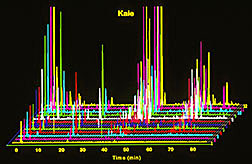 High-performance liquid chromatographs—like this one, for kale—show the wide range of potential antioxidants in selected fruits and vegetables. Each needlelike peak represents a compound that can be oxidized and reduced. Foods with many peaks score high in total antioxidant capacity. (K7496-2) |
T-cell proliferation is a good measure of the overall function of the immune system, he explains, because the cells act as a kind of player coach. They not only attack invading organisms, they also coordinate the activity of other immune cells.
Adult Americans average 1.2 servings of fruit each day and 3.1 servings of vegetables—according to USDA's 1989-91 nationwide food consumption survey—with the dark-green and yellow vegetables eaten much less frequently. Bananas and white potatoes are the number-one fruit and vegetable, and both are low in carotenoids, says Clevidence.
"Increasing consumption of fruits and vegetables is an effective strategy for preventing diseases of aging," she says. "But, for the greatest health benefits, we need to identify those that provide optimum protection and emphasize their consumption."
The Fruit, the Whole Fruit, and Nothing but . . .
Another group of ARS researchers is taking a different approach to assaying protective effects of fruits and vegetables. Led by Ron Prior at the Jean Mayer USDA Human Nutrition Research Center on Aging at Tufts in Boston, Massachusetts, this group is finding that blueberries, strawberries, red bell peppers, Concord grapes, and beets—along with several deep-green vegetables—are workhorses at disarming free radicals, at least in the test tube.
Recent large clinical trials have focused on specific antioxidant compounds in fruits and vegetables, such as beta carotene, vitamin C, or vitamin E. But "fruits and vegetables have many other antioxidant compounds," says Prior. "Much of the protection they confer against cancer, heart disease, and stroke may be from compounds other than these vitamins."
So he and colleagues Guohua Cao, Hong Wang, and Emin Sofic are determining the total antioxidant capacity of the fruit or vegetable itself, using a chemical assay developed by Cao (see page 7). And they're finding that a large group of usually colorful compounds, some of which are flavonoids, may be responsible for much of the antioxidant protection against peroxyl radicals produced in the test tube.
The peroxyl radical is an oxidizing agent akin to the type our cells generate day in and day out during ordinary metabolism, says Cao, who is a chemist and medical doctor.
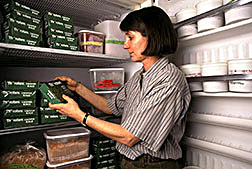 Test foods, like this frozen kale being checked by nutritionist Beverly Clevidence, were selected from single lots to ensure consistent amounts of carotenoids. (K7496-4) |
Prior's group ran the assay for total antioxidant capacity on more than a dozen commonly eaten fruits, five fruit juices, and more than a score of vegetables and other foods that they bought from Boston area supermarkets on three different occasions. They also tested green and black teas. Blueberries, strawberries, and Concord grape juice scored highest among the fruits and juices tested.
Three and one-half ounces of blueberries—about two-thirds of a cup worth—disarmed as many peroxyl radicals as 1,773 International Units (IU) of vitamin E or 1,270 mg of vitamin C did. Strawberries were more than half as potent as blueberries. Plums scored third, having nearly two-thirds the total antioxidant capacity of strawberries.
Among the 22 vegetables assayed, kale led the bunch with a total antioxidant capacity a little above that of strawberries, followed by spinach with about the same potency as plums. Three and one-half ounces of kale—an easily edible portion—disarmed as many free radicals as 837 IU of vitamin E or 599 mg of vitamin C did. Total antioxidant capacity of kale was about twice as potent as beets and broccoli flowers, 8 to 9 times more potent than carrots and string beans, and 29 to 35 times more potent than celery and cucumber.
Cao says that garlic tested higher in antioxidant capacity than fresh kale because it has so little water. But this favorite of herbal medicine dropped to the low end of the pack when the vegetables were compared on a dry-weight basis. And few of us but the most stouthearted can eat 3.5 ounces of garlic at a sitting.
The Boston researchers also tested strawberries and all the vegetables against two other oxidizing agents generated via normal metabolism—the hydroxyl radical and copper ions.
In earlier studies, Cao had found that vitamins C and E can actually be turncoats while in the company of transition metals—such as copper or iron ions—and become oxidizing agents themselves. That did not happen when the whole fruit or vegetable extract was pitted against copper ions, says Cao.
"Whole fruits and vegetables contain a mixture of natural antioxidants that can protect the vulnerable compounds.”
Which of these compounds get absorbed by the body and increase protection from oxidative stress or improve health in some other fashion? The researchers are currently conducting studies on rodents to get some preliminary answers.
"If the animal studies produce positive results," says Prior, "it gives us a measure of the quality of foods other than the common nutrients biomedical science has been looking at."
Future research will evaluate the potential of this method to add to the understanding of how phytochemicals convey protective effects. -- By Judy McBride, ARS.
Beverly A. Clevidence is at the USDA-ARS Beltsville Human Nutrition Research Center, 10300 Baltimore Ave., Beltsville, MD 20705-2350; phone (301) 504-8367
Ronald L. Prior is at the Jean Mayer USDA Human Nutrition Research Center on Aging at Tufts University, 711 Washington St., Boston, MA 02111; phone (501) 364-2747
The ORAC Assay Automated
 To determine total antioxidant activity, visiting scientist Guohua Cao loads extracts of fruit and vegetable samples onto an automated centrifugal analyzer. (K7494-1) |
Several methods have recently been developed to measure the total antioxidant capacity of biological samples. But the ORAC (Oxygen Radical Absorbance Capacity) method is unique, says developer Guohua Cao.
ORAC measures the degree to which a sample inhibits the action of an oxidizing agent and how long it takes to do so. Then it integrates the two measurements into a single one. This provides an accurate and reproducible measurement for different types of antioxidants having different strengths.
The assay combines a chemical marker that fluoresces with the test sample and an oxidizing agent, such as the peroxyl radical, the hydroxyl radical, or metal ions. The test sample can be a biological sample, such as blood serum, tissue, or a food extract; or a chemical sample, such as vitamin E.
As long as the antioxidant in the test sample disarms the free radicals, the marker stays intact and continues to fluoresce. A detector in the analyzer measures the strength of the light emitted from the marker. As the antioxidants become spent, more and more of the marker is destroyed, and fluorescence eventually drops to zero. Unlike other methods, ORAC accounts for all inhibition—from the beginning of fluorescence, to zero.
In 1994, Cao brought his method to the Boston center to work with Ron Prior. But it was time-consuming, particularly for the analyses of large numbers of samples. So they automated the ORAC assay by adapting it to work in a COBAS FARA II analyzer and linking the analyzer to a computer to store the data on a hard disk. The analyzer uses robotics to precisely add the samples and control the reaction timing.
Now, the researchers can determine the total antioxidant capacity of a dozen samples in little more than an hour. ORAC, as now automated, is a relatively simple but sensitive technique that affords nutritionists, epidemiologists, and clinicians a reliable and convenient tool for studying the role of oxygen free radicals in disease processes or for assessing the protective effects of antioxidants.
However, the COBAS FARA II analyzer is no longer available, so the researchers are working with other equipment manufacturers to develop an instrument suitable for wide applications—and one that can analyze more samples at the same time. — By Judy McBride, ARS.
"Plant Pigments Paint a Rainbow of Antioxidants" was published in the November 1996 issue of Agricultural Research magazine.
