
United States Department of Agriculture
AgResearch Magazine


“Power Plants” Prevail at the National Arboretum
|
|
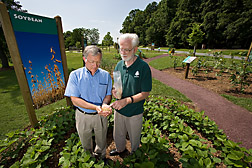
A new exhibit at the U.S. National Arboretum (USNA) interweaves hundreds of plants in an adroit arrangement of foliage, blossoms, space, and light to captivate the senses—and tell a story.
“Power Plants” is an inventive display of more than 20 different kinds of plants that are now serving or might someday serve as a source of renewable energy in the United States. Some of these—like corn and soybeans—are already well known.
But many people are unaware of the bioenergy potential of a hybrid poplar tree or in biofuel contenders like Cuphea and Camelina. Much more research is needed to identify the key plants that could play a part in large-scale energy production. The Power Plants exhibit contains unique signage and displays that explain to visitors how each plant can be converted to energy and what its production potential is.
In the meantime, these “green” candidates need more press. USNA provided a perfect stage for focusing a timely spotlight on some of the plants being studied—and for raising public awareness of and familiarity with them.
|
|
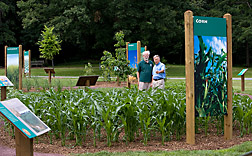
“At the National Arboretum, we’re always looking for opportunities to develop exhibits that are relevant to current issues,” says USNA director Tom Elias. “We thought that a presentation on biofuels would give our visitors an opportunity to learn more about the diversity of plants that can be used as alternative fuel sources.”
USNA is part of USDA’s Research, Education, and Economics (REE) mission area and is under the management of the Agricultural Research Service (ARS). Gale Buchanan, the REE Under Secretary, is a strong advocate of bioenergy research. He supported development of the Power Plants exhibit from the start.
“Energy security for our country is one of the most important challenges in our lifetime,” Buchanan says. “What better way is there to explain USDA biofuels research to the public?”
The three other REE agencies were also enthusiastic about the Power Plants exhibit. The Cooperative State Research, Education, and Extension Service; the Economic Research Service; and the National Agricultural Statistics Service all joined forces with USNA to grow this new garden.
Clearing the Land
The space chosen for the exhibit occupies about an acre of ground near the USNA visitor center and administrative offices in northeast Washington, D.C. USNA staff began preparing the site in the fall of 2007 and worked through the winter to make sure the exhibit would open on time.
Every good gardener knows that the proper groundwork is crucial to the success of a garden. USNA Gardens Unit leader Scott Aker watched over the site preparation.
“Fortunately, the site is well-drained, and all the plants we’re using are adapted to a wide variety of soils,” Aker says. “We didn’t need to use a lot of fertilizers or other soil amendments to support the plants.”
Aker’s bigger challenge was familiar to exhibit curators everywhere: developing an “interpretation” of field crops, like corn or sugarcane, that conforms to a garden setting.
“Field crops are not ornamental,” he says. “Acres and acres of sunflowers are a breathtaking sight, but the producer doesn’t care if the sunflowers have petals or not. The most crucial thing about them is their seed output.”
Working around the various timetables for plant development also presented some unusual challenges. “It’s impossible to get a sugar beet to maturity by June 21 in Washington, D.C.,” Elias notes.
But the designers carefully studied the range of plant textures, colors, sizes, and seasonality and mapped out a landscape that would intrigue visitors following along the garden’s walkways. A range of government agencies—and even some private companies—donated starter seeds, but USDA germplasm collections were an invaluable source for many of the plants.
Just Add Sunlight
The Power Plants exhibit officially opened for visitors on June 21—the day after this year’s summer solstice, when the Northern Hemisphere receives the maximum amount of daylight because of the tilt of the Earth’s axis.
Buchanan also designated this date as USDA’s “Bioenergy Awareness Day.” He invited representatives from universities and other research institutions across the country to present their bioenergy activities at a 2-day event at USDA headquarters in Washington. The theme of this year’s event was “Agriculture: Tomorrow’s Energy.”
ARS scientists nationwide are conducting research to make that theme become a reality. The ARS national program in Bioenergy and Energy Alternatives (#307) is focused on integrating the three aspects of biofuels research: feedstock development, feedstock production, and biorefining (feedstock conversion and coproduct) development.
Scientists have assessed the economics and energy efficiencies of different bioenergy production systems and highlighted concerns associated with biofuel-crop cultivation and harvest. They have also evaluated key genetic characteristics in plants that could enhance biofuel output.
“We would like to develop an on-farm system that is totally self-sustaining,” says ARS Administrator Ed Knipling. “One possibility is that a farmer could grow crops to use for biofeedstock and then use small-scale technology to convert the biofeedstock into fuel for onsite energy generation.”
In the meantime, Buchanan, like every other gardener with a piece of land and a horticultural goal, is extremely proud of the Power Plants exhibit.
“It’s a great showcase for ARS research,” he says. “It lets folks know what we’re doing in USDA to address our country’s very important energy issues.”—By Ann Perry, Agricultural Research Service Information Staff.
This research is part of Plant Genetic Resources, Genomics, and Genetic Improvement (#301) and Bioenergy and Energy Alternatives (#307), two ARS national programs described on the World Wide Web at www.nps.ars.usda.gov.
Tom Elias is the director of the U.S. National Arboretum, 3501 New York Ave., N.E., Washington, DC 20002-1958; phone (202) 245-4539, fax (202) 245-4574.
Potential Ethanol Feedstocks
|
Ethanol From Grains: To make ethanol from grains, the raw grain is liquefied and then converted into sugars. The sugars are fermented by microorganisms such as yeast to produce ethanol and carbon dioxide. |
| Click on individual photos for a higher resolution image. | ||
 |
Corn Zea mays (D1156-8) |
Maize was domesticated about 9,000 years ago from a wild Mexican ancestor, teosinte. Ethanol produced from corn grain is perhaps the best known contender in biofuels development and is already widely available in the United States. |
 |
Barley Hordeum vulgare (K3936-13) |
Barley was domesticated by 8000 B.C., probably in the Middle East. Hull-less barley can be grown in winter on the same land used for summertime corn and soybean production—thus preventing winter soil erosion—and requires fewer soil amendments for cultivation. |
 |
Sorghum Sorghum bicolor (D1153-1) |
It isn't clear whether sorghum—which originated in Africa—was domesticated in Africa or in India. Despite its tropical origins, it has become well adapted to growing conditions in temperate regions. |
|
Ethanol From Sugar: Some estimates suggest that converting sugar to ethanol requires only about half the energy needed to convert corn grain to ethanol. |
||
 |
Sugar beet Beta vulgaris (K11110-2) |
Leaf beets were originally domesticated in the Mediterranean, whereas sugar beets and other beet varieties were developed mainly in northwestern Europe. For biofuel use, raw sugar beets are processed to obtain refined sugar, which is then converted to ethanol. |
 |
Sugarcane Saccharum officinarum (K5602-1) |
Sugarcane was domesticated in Papua New Guinea some 10,000 years ago. Current breeding efforts and agronomic studies are focused on developing varieties with high biomass yield and increased cold tolerance, which would also allow for a longer harvest season. |
|
Ethanol From Plant Cellulose: Cellulosic ethanol is made by fermenting sugars that have been extracted from plants or other raw feedstock, such as sawdust and paper pulp. But these sugars–cellulose and hemicellulose–are stored in the plant cell walls. A key challenge in making cellulosic ethanol lies in finding cost-effective methods for extracting the sugars from these rigid cellular structures. |
||
 |
Switchgrass Panicum virgatum (D647-5) |
Switchgrass, a prairie grass native to North America, has been used in the United States for conservation plantings and cattle feed. Its biofuel potential stems from its wide adaptability and high yields, the relatively low level of inputs required for biofuel production and conversion, and its ability to sequester carbon in soils for extended periods. |
 |
Poplar Populus hybrids (D1253-1) |
Hybrid poplar trees are crosses between two or more species of Populus and are characterized by rapid growth and easy propagation. |
| Miscanthus Miscanthus x giganteus | Miscanthus grasses are native to Asia and were introduced into the United States mainly for ornamental use. Research suggests that Miscanthus plants can produce high levels of biomass for up to 15 years | |
  |
Alfalfa |
Alfalfa originated in the Middle East, and both domesticated and related perennial species are now found throughout Eurasia—all the way to Siberia. It is grown in every U.S. state, mainly for livestock feed. Unlike corn and other grass crops, alfalfa obtains nitrogen from the air, which boosts production efficiency and savings. |
Potential Biodiesel Feedstocks
|
Biodiesel From Oilseed Plants: Biodiesel is produced by extracting oil in oil-rich seeds. It is possible to use this raw extracted oil as a fuel without further processing, but additional steps result in a higher quality fuel. |
| Click on individual photos for a higher resolution image. | ||
 |
Sunflower Helianthus annuus (K5752-10) |
Sunflowers originated in North America and were grown for food and hair oil by Native Americans. Sunflower seeds contain a higher percentage of oil than soybean seeds, but their higher price—and continued popularity as a food—may impede their use for biodiesel. |
 |
Soybean Glycine max (K8324-3) |
A key source of vegetable oil in the United States, soybeans were domesticated in China—possibly as far back as the 11th century B.C.—and are currently the leading provider of protein and oil around the globe. |
| Canola Brassica juncea, B. rapa, and B. napus |
Varieties of Brassica have been grown in Europe and Asia for at least 2,000 years, with one primary center of diversity in the Himalayan region. Canola-quality cultivars were developed in Canada during the 1970s. | |
| Camelina Camelina sativa |
Camelina originated in areas from the Mediterranean to Central Asia and was cultivated in antiquity from Rome to southwest Asia. It can be grown on fallow land unsuitable for most other crops. | |
 |
Castor bean Ricinus communis (K9198-1) |
Originally from East Africa, the castor oil plant is now found in warm regions worldwide. Castor bean oil has been used in medicine, printing, dyeing and machine lubrication. But the bean also produces a substance—ricin—which is a deadly toxin. |
 |
Peanut Arachis hypogaea (D1152-4) |
The cultivated peanut originated in South America and is one of the world's leading sources of cooking oil. It is mainly a warm-temperate/tropical crop. A diesel engine powered completely by peanut oil was exhibited at the Paris Exposition in 1900. |
 |
Lesquerella Lesquerella fendleri (K4692-13) |
Lesquerella is native to the southwestern United States, and the oil it produces is similar in composition to castor oil, all of which is currently imported. Potential Lesquerella oil products include biodiesel, biolubricants, biodegradable plastics, coatings, and cosmetics. |
| White mustardSinapis alba | Probably a Mediterranean native, white mustard has become naturalized in Eurasia and North America and is considered a weed in some regions. Currently, it is grown for its seeds—which are used to make mustard—and for fodder. | |
 |
Brown mustard Brassica juncea (K11449-1) Black mustard Brassica nigra (D1130-1) |
Different varieties of mustard—among the oldest recorded spices, with Sanskrit records dating back to about 3000 B.C.—are native to temperate regions of Europe. A pesticide from the hulls of mustard seeds can be generated as a coproduct of mustard biodiesel. |
 |
||
| Jatropha Jatropha curcas |
Native to Mexico, the Jatropha shrub is now found globally in tropical and subtropical areas. It can grow on barren, marginal land, but its toxic seeds and leaves require careful handling. Energy experts in China and India are studying its potential for large-scale biodiesel production. | |
 |
Cuphea Cuphea hybrid (K8681-2) |
Some 250 undomesticated species of Cuphea are native to Central America, South America, and North America. Oil from Cuphea seeds has a low viscosity and can be used directly as a diesel fuel without chemical processing. It also shows promise for controlling weeds in turfgrass. |
| African oil palm Elaeis guineensis |
The African oil palm originated in the tropical rain forest region of West Africa and is cultivated in many other tropical countries. It can grow to heights of almost 100 feet, but cultivated trees are typically 30-50 feet tall. | |
 |
Algae (K10333-1) |
More than 100,000 strains of algae have been identified. Many of them grow rapidly and can be cultivated to develop high oil content, often more than 60 percent of their biomass. Basic production requirements are simple: water—even saline water—and carbon dioxide. |
"“Power Plants” Prevail at the National Arboretum" was published in the October 2008 issue of Agricultural Research magazine.
