


This page has been archived and is being provided for reference purposes only. The page is no longer being updated, and therefore, links on the page may be invalid.
Read the magazine story to find out more. |
|
|

Switchgrass: Bridging Bioenergy and Conservation
By Linda TokarzSeptember 13, 2007
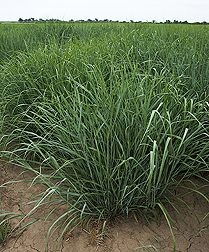
An important part of the answer to the country's energy woes could be blowing in the prairie wind, according to Agricultural Research Service (ARS) plant geneticist Michael Casler. He has spent the past 10 years breeding switchgrass, an eight-foot-plus native plant that was an integral part of the tall grass prairies that once dominated America's Midwest.
As a breeder, Casler is mostly concerned with the plant's bioenergy-friendly attributes, including its ability to accumulate large amounts of biomass and tolerate environmental stress. Casler works at the agency's U.S. Dairy Forage Research Center in Madison, Wis.
Recently, he began looking at switchgrass from another standpoint—as a restorer of once-pristine prairies. Historically, a sprawling seas of grasses once stretched from Montana and the Dakotas down to Texas, with pockets of prairie as far east as New York. Now, with much of this land fragmented or altered, only a patchwork of remnant prairies remains.
Numerous federal, state and private conservation efforts are examining how best to revive these vestigial prairies. But a question of genealogy always arises: Which switchgrass varieties should be planted that will be in keeping with a site's genetic legacy?
Some conservationists insist on using only long-established, local varieties of switchgrass. Others argue that modern-day cultivars can appropriately be used.
Along with ARS scientist Kenneth Vogel in Lincoln, Neb., Casler set out to bring clarity to this debate and, hopefully, ease the task of grassland restoration.
After two summers spent trekking native Midwestern prairies, plucking samples and sending them back to his laboratory, Casler discovered that today's agronomically important switchgrass cultivars are nearly identical genetically to their grassy ancestors.
The study's findings are good news for prairie restorers, who can confidently tap a wider pool of switchgrass cultivars and local varieties for conservation projects. And switchgrass growers can take satisfaction knowing their fields still are, in many ways, symbolic of the country's rich grassy past.
Read more about the research in the September 2007 issue of Agricultural Research magazine.
ARS is the U.S. Department of Agriculture's chief scientific research agency.
