


This page has been archived and is being provided for reference purposes only. The page is no longer being updated, and therefore, links on the page may be invalid.
|
|
|
|
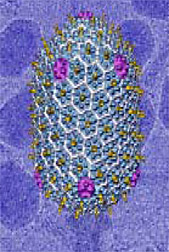

Virus Enzymes Could Promote Human, Animal Health
By Laura McGinnisAugust 14, 2009
Could viruses be good for you? Scientists with the Agricultural Research Service (ARS) have shown that enzymes from bacteria-infecting viruses known as phages could have beneficial applications for human and animal health.
Phage enzymes called endolysins attack bacteria by breaking down their cell walls. Unlike antibiotics, which tend to have a broad range, endolysins are comparatively specific, targeting unique bonds in the cell walls of their hosts. This is significant because it means non-target bacteria could be less likely to develop resistance to endolysins.
Researchers at the ARS Animal Biosciences and Biotechnology Laboratory in Beltsville, Md., in collaboration with federal, university and industry scientists, have developed and are patenting technology to create powerful antimicrobials by fusing genetic material from multiple cell-wall-degrading endolysins. Now the researchers are collaborating with biopharmaceutical companies to evaluate and further develop the technology.
Studies led by ARS biologist David M. Donovan show that phage enzymes could be used to wipe out multi-drug-resistant pathogens that affect both animals and humans, such as methicillin resistant Staphylococcus aureus, also known as MRSA.
The scientists showed that the enzymes can knock out pathogens in biofilms, which are matrices of microorganisms that can attach to a variety of surfaces. Biofilms are resistant to antibiotics and contribute to many human infections.
In a related study, the scientists showed that using the endolysins lysostaphin and LysK in concert inhibited the growth of staphylococcal strains that cause mastitis in cattle and staph infections in humans.
This research was published recently in the journal Biotech International.
This work is supported in part by the U.S. Department of Agriculture's Cooperative State Research, Education and Extension Service, the National Institutes of Health, and the U.S. Department of State.
ARS is the USDA's principal intramural scientific research agency.
