
United States Department of Agriculture
AgResearch Magazine


Tracking an Attacker—of Saltcedar
|
|
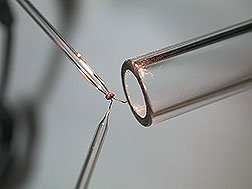
Monitoring an introduced leafbeetle's attacks on saltcedar could become an easier task now that scientists have synthesized the beneficial insect's chemical attractant, or pheromone.
Saltcedar (Tamarix)—the beetle's favorite food—is an invasive tree from Eurasia that's become established in 20-plus U.S. states, costing $100 million annually in degraded wildlife habitat, increased soil salinity, water quality and quantity problems, and other harm. The beetle, Diorhabda elongata, is a natural enemy that's being tested in seven western states as a biological control agent. (See "Beneficial Beetles Take a Bite Out of Saltcedar" in this issue.)
Monitoring the beetle's spread outward from the release site is a key part of ARS's biologically based integrated weed-management approach. So say Robert Bartelt and Allard Cossé, entomologists who identified and synthesized the beetle's pheromone—and saltcedar scents that attract the insect—in studies at ARS's National Center for Agricultural Utilization Research, Peoria, Illinois.
It's very important to know how far, how quickly, and in what directions the beetles move and how successful they might be in establishing new zones of infestation. Currently, beetle monitoring requires a sharp eye, dexterity with a sweep net, and a keen sense of direction while trekking through 12-foot-high thickets of saltcedar.
"This is where the pheromone and saltcedar scent come into play; they help us detect beetles quickly and with great sensitivity—far better than a guy with a butterfly net!" says Bartelt. Sticky traps baited with these attractants are deployed in a range of saltcedar patches to determine whether the beetles are moving in.
In the lab, Bartelt and Cossé began the attractant research by first placing male or female beetles in a special glass tube containing a sprig of saltcedar. Any scents emitted by the beetles—or chewed saltcedar leaves—were collected for identification by a gas chromatograph-mass spectrometer. Compounds emitted by just one sex were considered likely to be pheromone components.
Then, using a technique called "electroantennographic detection," the researchers measured electrical stimulation triggered in the antennae of severed beetle heads by the various collected chemicals. Two male-specific compounds—an alcohol and an aldehyde—were readily detected by the antennae, as would be expected for pheromones. From affordable, off-the-shelf chemicals, the researchers then made a synthetic version of these compounds.
Field tests last year confirmed the compounds' potential. More tests are planned as part of the ARS-led Saltcedar Biological Control Consortium.
The scientists used the same approach to synthesize saltcedar odors. Interestingly, mixing these odors with the synthetic pheromone worked better than either used alone. "We're now trying to improve the blend of these two scents," says Bartelt.—By Jan Suszkiw, Agricultural Research Service Information Staff.
This research is part of Crop Protection and Quarantine, an ARS National Program (#304) described on the World Wide Web at www.nps.ars.usda.gov.
Robert J. Bartelt and Allard A. Cossé are in the USDA-ARS Crop Bioprotection Research Unit, National Center for Agricultural Utilization Research, 1815 N. University Street, Peoria, IL 61604; phone (309) 681-6237 [Bartelt], (309) 681-6217 [Cossé], fax (309) 681-6693.
"Tracking an Attacker—of Saltcedar" was published in the April 2005 issue of Agricultural Research magazine.
