



| July 2017 |
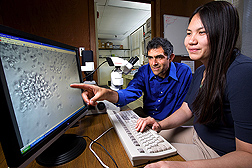
A Faster, Less Costly Test Detects Foodborne ToxinAgricultural Research Service scientists have developed a new test that's faster, more sensitive and less expensive than current tests in detecting the major foodborne toxin staphylococcal enterotoxin type E (SEE). The bacterium Staphylococcus aureus, which makes a variety of toxins including SEE, is one of the most common causes of food poisoning. The new test is based on a T-cell, a type of white blood cell that helps with the body's immune system responses. It specifically detects SEE in foods. The current method for detecting these toxins is an animal model, which is expensive, has low sensitivity and is difficult to reproduce. Other tests used to detect toxins cannot distinguish between active toxin, which does pose a threat to public health, and inactive toxin, which does not. The animal-model test detects active toxin only 50 percent of the time compared to the new T-cell test, which detects it 100 percent of the time. The T-cell test also detects toxin within five hours compared to 48 to 72 hours for other tests. For details, contact: Reuven Rasooly, (510) 559-6478, Foodborne Toxin Detection and Prevention Research Unit, Western Regional Research Center, Albany, California. |
|
|
|
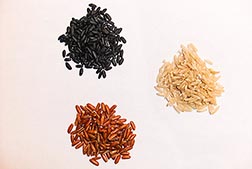
Colored Rice May Brighten the Menu for Diabetics in the FutureThe impact of brown, purple and red rice bran on mice fat cells was examined by Agricultural Research Service scientists as a model for developing methods to help with diabetes management. They studied the colored rice bran extracts' ability to stimulate glucose uptake in the mice fat cells. Glucose uptake nearly tripled in mice fat cells exposed to red rice bran extracts and more than doubled with purple rice bran extracts. While these results showed promise regulating glucose uptake in mice fat cells, additional research is needed to verify the same positive effect in humans. For details, contact: Stephen Boue, (504) 286-4346, Food Processing and Sensory Quality Research Unit, Southern Regional Research Center, New Orleans, Louisiana. |
Cooking Meatballs That Are Safe to EatUndercooked meatballs are a potential source of Shiga toxin-producing Escherichia coli (STEC). Each year, STEC cause an estimated 265,000 illnesses, 3,600 hospitalizations, and 30 deaths in the United States, according to the Centers for Disease Control and Prevention. Establishing a standard set of times and temperatures for safely cooking meatballs is challenging. Chefs and consumers prepare them from different meats, store them at different temperatures (refrigerated and frozen), and cook them at different temperatures and for different times. Agricultural Research Service scientists have determined some practical methods for safely cooking meatballs at home, in restaurants, or in commercial or institutional kitchens. They found that deep-frying frozen meatballs for 9 minutes or oven baking them for 20 minutes reduced E. coli levels 100,000-fold, a target referred to as a "5-log reduction" that made them safe for consumption. The refrigerated meatballs required 5.5 minutes in the deep fryer and 12.5 minutes in the oven to achieve the same "5-log reduction." For details, contact: Anna Porto-Fett, (215) 836-3762, Food Safety and Intervention Technologies Research Unit, Eastern Regional Research Center, Wyndmoor, Pennsylvania. |
|

|
|
Making Melons Safer with SteamSteam can more effectively combat E. coli, Salmonella, and Listeria on cantaloupes than traditional removal methods. Agricultural Research Service researchers have demonstrated that a relatively inexpensive steam cleaner designed to remove wallpaper and clean outdoor grills can rid cantaloupes of E. coli, Salmonella, and Listeria more effectively than existing washes and chlorine treatments. Pathogen levels on the surfaces of the steam-treated melons were generally 1,000 times lower than those on untreated melons. Pathogens on cut-up pieces of the cantaloupes were reduced beyond detection. Pathogen levels on steam-treated cantaloupes were about 100 times lower than those found on cantaloupes sanitized with chlorine For details, contact: Dike O Ukuku, (215) 233-6427, Food Safety and Intervention Technologies Research Unit, Food Technology Unit, Eastern Regional Research Center, Wyndmoor, Pennsylvania. |

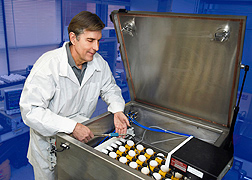
A Better Way to Pasteurize EggsAgricultural Research Service scientists have developed a technology that rapidly pasteurizes eggs and could sharply reduce the number of illnesses caused each year by egg-borne Salmonella bacteria. Current pasteurization methods involve immersing eggs in hot water (130 to 140 degrees Fahrenheit). The process takes about an hour and adds about $1.50 to the retail price of a dozen eggs. This new technology uses radio frequency (RF) waves to heat eggs and reduce Salmonella without damaging egg whites. The patented RF process is faster and ensures that the protein-rich yolk gets more heat than the egg white. It also should lower the cost of pasteurization—and the price of pasteurized eggs on store shelves. If pasteurized eggs become less expensive and more abundant, more people are likely to choose them, and fewer people will get sick. RF technology is already used to reduce pathogens in almonds, spices, wheat flour and other food products. For details, contact: David J. Geveke, (215) 233-6507, Food Safety and Intervention Technologies Research Unit, Eastern Regional Research Center, Wyndmoor, Pennsylvania. |
|
|
|
Making Spinach with Low Oxalate LevelsAgricultural Research Service scientists have identified 8 spinach varieties that have low oxalate levels, which is sometimes linked to better health. Oxalic acid, or "oxalate," is a naturally occurring plant chemical and in the human diet it's been linked to kidney stone formation. It also can react with calcium, iron, and other minerals to inhibit mineral absorption. The scientists analyzed oxalate concentrations in 300 USDA germplasm accessions and 10 commercial cultivars and found oxalate concentrations that ranged from 647.2 to 1,286.9 mg per 100 grams on a fresh weight basis. For details, contact: Beiquan Mou, (831) 755-2893 (831) 755-2893, Crop Improvement and Protection Research Unit, Salinas, California. |
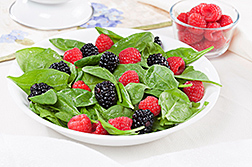
Science Confirms - You Really Should Eat Your BrassicaBrussel sprouts, kale, cabbage and 27 additional varieties of Brassica microgreens have been analyzed for their phytochemical, vitamin and mineral content. While mineral concentrations in microgreens varied by species and variety, the most abundant macroelement found was potassium, followed by phosphorus, calcium, magnesium and sodium. Potassium values were highest in wasabi microgreens and lowest in daikon radish microgreens. Savoy cabbage microgreens had the highest calcium levels. Microgreens are an emerging class of specialty fresh produce which have gained popularity with chefs and consumers, and positively impact diets. For details, contact: Yaguang Luo, (301) 504-6186, Food Quality Laboratory, Beltsville Agricultural Research Center, Beltsville, Maryland. |
|

|
|
2017 ARS W.O. Atwater Memorial Lecturer Renews Call for Excellence in Nutrition Research"Traveling the Road from Precision to Imprecision: Have I Gone in the Wrong Direction?" is the title of Dennis M. Bier's 2017 Agricultural Research Service W. O. Atwater Memorial Lecture, which he delivered at the Experimental Biology 2017 meeting in Chicago on April 25. Bier is a renowned advocate for the highest standards of experiment design and increased rigor in nutritional research. He has forcefully promoted the need to enhance the quality of data that nutrition research is generating, especially data used for formulating nutrition guidelines and recommendations. Bier is the director of the Children's Nutrition Research Center at Baylor College of Medicine in Houston. He also is the only person to serve as president of all three major academic nutrition societies: the American Society for Clinical Nutrition, the American Society for Nutritional Sciences and the American Society for Nutrition. For details, contact: Kim Kaplan, 301-504-1637, ARS Office of Communications, Beltsville, Maryland. |

National Inventors Hall of Fame Honors ARS ScientistAllene Rosalind Jeanes, an Agricultural Research Service chemist in Peoria, Illinois, from 1941 to 1976, was inducted into the National Inventors Hall of Fame in May. Jeanes, who died in 1995, used her background in carbohydrate chemistry to discover how to mass-produce dextran for use as a blood volume "expander" to sustain accident and trauma victims suffering from significant blood loss. Her research saved countless lives on the battlefields of Korea and during the years that followed. Jeanes also developed xanthan gum, a sugar synthesized by bacteria. Approved in 1968 by the U.S. Food and Drug Administration as a food additive, xanthan gum is widely used today in products such as toothpaste, egg substitutes, ice cream and some gluten-free foods. For details, contact: Dennis O'Brien, 301-504-1486, ARS Office of Communications, Beltsville, Maryland. |
|

|
|
Eat Your Greens-Microgreens, That is!Mice on high-fat diets along with either mature red cabbage or red cabbage microgreens had lower blood-cholesterol levels and less liver inflammation than mice on high-fat diets without the vegetable, according to an Agricultural Research Service study. In addition, mice on diets with red cabbage microgreens had lower levels of "bad" cholesterol than mice on diets with mature red cabbage. For details, contact: Thomas Ty Wang, (301) 504-8459 ext. 239, Diet, Genomics and Immunology Laboratory, Beltsville Agricultural Research Center, Beltsville, Maryland. |
